Date: April 2, 2007 - Author:
We took a look at a PC2-7200 kit from OCZ last year and it proved to be one of the best kits we've ever laid our mitts on. Today we are taking a look at another PC2-7200 kit, approved and branded by NVIDIA. Are we going to be impressed once again?
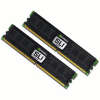
When OCZ first released their XTC heatspreaders in late 2005, who knew what was to follow? Since that time, we've seen many spreaders based off of the XTC and some entirely new ones, such as the Flex XLC and Reaper HPC. The kit we are looking at today takes care of something I've wanted ever since I first laid eyes on the XTC... the color. To me, nothing looks cooler than black, whether it be the product itself or the PCB. Sadly, the PCB on these modules are not the same color as the spreader... but hey, we can't have it all.
Last year, I had taken a look at an incredibly similar kit to this one. In fact, it has the same specs, the only difference is the black spreader. It was not until I received these new ones that I realized how similar they were. This could be a good thing though. The Platinum 7200 was one of my favorite kits of last year. They looked great and offered extreme performance for the price. I am hoping to be equally impressed today.
One thing you might notice right away is that these are "SLI-Ready" modules. What does that mean to you, the consumer? Not to steal thunder from OCZ, but not much of anything. It means that NVIDIA has taken a look at these modules and certified them for use in NVIDIA motherboards. As you'd expect, NVIDIAs own EPP technology can be found here, which are profiles within the SPD that is used to safely overclock.
When it comes to special memory kits that OCZ offers, they don't use their usual orange-backed graphics but instead new product specific ones. The past few kits I've taken a look at feature cool abstract art which really helps make the product stand out and appear modern. Kudos to their designers.
Because these are specially branded modules, the OCZ "Z" in the center has been replaced with the NVIDIA SLI READY badge. It looks good, because it's a brushed aluminum badge and not some boring sticker. These will look great in any PC... especially if you use NVIDIA products. For ATI fans, OCZ also offers ATI Certified kits with red heatspreaders, but they only come in PC2-5400 and PC2-6400 flavours.
These are great looking modules, I really dig the color. I am glad they chose black instead of NVIDIA green... I am not sure how well that would have worked.
For those who were wondering, yes, there actually is a badge on each side of the module.
Onward to overclocking and testing.
Since I had taken a look at the "non-NVIDIA" version of this ram before, I figured the overclocking potential would be similar. Well, the kit didn't let me down at all; I'm quite impressed. Although I couldn't push it up to speeds that the OCZ Flex 9200 offers, I came close to sit at 600MHz with 5-5-5-18-13 timings at 2.4v.
I need to make one thing clear though, as there seems to be a lot of confusion lately regarding what I consider to be a "max" overclock. I don't conclude with an overclock setting unless it passes 1000% in MemTest for Windows as well as a full 3D Mark 06 run to prove that it's fully 3D stable. In this case, I got caught up with other things while working on this review, so I allowed it to go a full 1800% to prove it's stability.
This is a 33% overclock, which is made impressive due to the fact that it's 100% stable.
Now I have to admit, higher speeds -might- be possible. The past few days have been ridiculous weather wise, so the room has hovered between 80°F - 91°F at any given time. Yes, it's not comfortable! If 600MHz proves stable at these ambient temps, I believe with a cooler environment, slightly higher clocks will be possible. I would not expect it to go far beyond 610MHz though, unless you use more than 2.5v.
Throughout all of our benchmarks regardless of what we are reviewing, testing is done in a clean and stand-alone version of Windows XP Professional with SP2. Prior to testing, these conditions are met:
The testing rig used for today's benchmarking is as follows:
Most of the results listed deal with how all of our settings scaled, although there will be direct comparisons to other kits of ram as well. You will note that I did not benchmark at all at the stock speeds. This is because the ram was able to clock far beyond stock speeds. So for the sake of congruency, I followed the same overclocking rates as previous reviews. However here, the 600MHz top overclock was used.
Sandra is always the first benchmark to come to mind when we need to do memory benchmarking. Or CPU benchmarking. Or storage benchmarking. You get the idea. It's a superb all-around tool that we rely on quite often.

Great results, but I'm mostly pleased to see that this kit managed to break through the 6K mark.
Next on the list is Everest 3.5, with it's read/write and latency tests. We broke through the 8K mark in our read tests and came close to 5,500 in our write. These benchmarks are heavily CPU bound as well though, so the higher your CPU frequency, the better effects your memory overclocks will have.


This is not a memory benchmark per se, but rather one that stresses a single core of your CPU to it's full potential. Because it crunches such an insane amount of digits, tighter timings and faster memory generally offers better results. We choose to run with an 8 million test, as anything lower flies by too fast on a Core 2 Duo and it's hard to generally see the differences that way.

Thanks to our overclock, we crunched 8 million digits in just under 4 minutes. Not terribly impressive, thanks to the fact we couldn't reach a slightly higher CPU overclock.
Though it's no longer in development, Sciencemark is a tool I still like to keep in my chest... err thumb drive. It gives results far more in-depth than other benchmarking programs out there, although you'd have to be an engineer to care for -all- the information it delivers. It generates a bandwidth result just like Everest and Sandra does, and is effected by higher CPU clocks.

We didn't break 6,000 here, but we came incredibly close!
Here, we compare our overclocks of the memory being reviewed alongside other recently evaluated sticks. These graphs include benchmarks with each kit of ram at DDR2-1000 4-4-4-12-13 2.1v along with each kits own top overclock. While the DDR2-1000 results should not vary much, the top end overclocks will, given that each kit will top out differently.
For reference, here are the top overclocks for each kit of ram included:
The result is never much of a surprise here, because it's all based on who has the best overclock. Whoever has the best ram overclock will also have the best CPU overclock. So, since the 7200 kit scored the lowest overclock of the bunch, that conclusion is reflected in the graph.


The same applies for our Super Pi tests. Surprisingly enough though, at 500MHz, OCZs 7200 kit scored the best time.

Given the fact that the OCZ 7200 has the lowest stock speed of all the other kits, it performed quite well overall.
Has the 7200 impressed us? Without question it has. The kit has a stock speed of 450MHz, but was 100% stable at 600MHz... a 33% overclock. That is an impressive feat. But here's where things get difficult. I can't really recommend this kit in particular, because it retails for a price higher than I'd like to see. One e-tailer sells for $390 and another for $292.
At $292, I feel this kit is worth it, thanks to it's potential. However, a quick search around the same retailers revealed that that PC2-8500 version of this kit actually costs less. Sometimes supply and demand can be funny, and this is a great example. In fact, one e-tailer is selling the PC2-8500 kit for $240 and at another, the kit will cost you $219 after a mail in rebate. Chances are good that the same chips are used in both the kit looked at today, and that one. With the PC2-8500 kit in hand, you should be able to achieve the same overclock as seen here, or even higher given they are higher binned chips.
As it stands, I am awarding the SLI-Ready PC2-7200 kit an 8 out of 10 in addition to our Editors Choice. Even at $292, I feel 600MHz stable is worth the price. However, as great as this kit is, it would only make sense to pick up the PC2-8500 version for the fact it costs far less.
If you have a comment you wish to make on this review, feel free to head on into our forums! There is no need to register in order to reply to such threads.


Copyright © 2005-2006 Techgage. All Rights Reserved. | Proudly hosted by Neosurge.