
- Qualcomm Launches Snapdragon 4 Gen 2 Mobile Platform
- AMD Launches Ryzen PRO 7000 Series Mobile & Desktop Platform
- Intel Launches Sleek Single-Slot Arc Pro A60 Workstation Graphics Card
- NVIDIA Announces Latest Ada Lovelace Additions: GeForce RTX 4060 Ti & RTX 4060
- Maxon Redshift With AMD Radeon GPU Rendering Support Now Available

Social & RSS Feeds
Latest Videos

Latest News
OCZ Gold XTC 2GB PC2-4200

by Rob Williams on March 20, 2006 in Miscellaneous
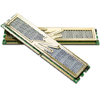
Are you in the DDR2 market and want a speedy kit at a good price? The kit we are looking at today have a modest DDR2-533 stock speed and fantastic 3-3-3 timings. They also turn out to be good overclockers, making them a good value.
Page 1 – Introduction
OCZ has been making quite the name for themselves over the past year. During that time, they released their new XTC heat spreaders and Rally thumb drive. It’s evident that they are not only producing products for the every day user, but enthusiasts. They have a wide range of memory products at many varying speeds and sizes… it can be really difficult to choose if you are looking to upgrade!
There are a total of five various series for OCZ modules, and we have taken a look at many of their Gold models in the past year. As if it were a medal, the Gold series are designed to offer superb performance out of the package, with no need for overclocking. Generally speaking, they are ‘value’ modules, but for people to crave top performance for that speed class. One thing the Gold are not known for is their overclock ability. On the DDR1 side of things, I found that if you were to get a nice overclock out of them, you would be very lucky. As for DDR2 though, I recently took a look at their 1GB PC2-5400 modules and they overclocked nicely to PC2-6600 speeds and still retained their stability.

The question now is whether or not people are going to continue purchasing 1GB kits when new games almost demand 2GB. You could always purchase another 1GB kit to have 4 total modules to amount to 2GB, but then you are stuck with slower performance due to 2T timings. It’s clear that 1GB * 2 is the way to go if you wish to have the best possible performance right now.
That being said.. the modules we are taking a look at today will be more appealing to the casual user, because the stock speed is not up to par with high-end modules. Of course, if these modules prove as overclockable as the PC2-5400 I took a look at last month, then that would make them an even better ‘value’.

These sticks are clocked at PC2-4200 speeds, which equates to DDR2-533. The timings are actually quite good on these modules, being 3-3-3-12. The stock timings and speed require 1.9v, and I didn’t go over 2.1v with them due to lack of active cooling. These modules have two things about them specifically that make them special:
XTC Heat spreader: XTC (Xtreme Thermal Convection) heat spreaders optimize the thermal management of memory modules by promoting greater airflow by means of micro-convection throughout what is usually the dead air space inside conventional heat spreader designs. In this manner, build-up of heat is avoided and thermal dissipation of the memory components is offloaded more efficiently through the honeycomb design. At the same time, mechanical stability is maintained.
Extended Voltage Protection: OCZ EVP (Extended Voltage Protection) is a feature that allows performance enthusiasts to use a VDIMM of 2.2V ± 5% without invalidating their OCZ Lifetime Warranty.

So in addition to the great heat spreaders, you get a lifetime warranty and the ability to pump up the volume.. err voltage to 2.2v ± 5% without invalidating it. I was unable to find out which memory chips these modules use before publishing time. Like the 512MB models, these may also use a variant of Infineon.
|
|

Support our efforts! With ad revenue at an all-time low for written websites, we're relying more than ever on reader support to help us continue putting so much effort into this type of content. You can support us by becoming a Patron, or by using our Amazon shopping affiliate links listed through our articles. Thanks for your support!

Rob Williams
Rob founded Techgage in 2005 to be an 'Advocate of the consumer', focusing on fair reviews and keeping people apprised of news in the tech world. Catering to both enthusiasts and businesses alike; from desktop gaming to professional workstations, and all the supporting software.


