
- Qualcomm Launches Snapdragon 4 Gen 2 Mobile Platform
- AMD Launches Ryzen PRO 7000 Series Mobile & Desktop Platform
- Intel Launches Sleek Single-Slot Arc Pro A60 Workstation Graphics Card
- NVIDIA Announces Latest Ada Lovelace Additions: GeForce RTX 4060 Ti & RTX 4060
- Maxon Redshift With AMD Radeon GPU Rendering Support Now Available

Social & RSS Feeds
Latest Videos

Latest News
NZXT Precise 650W

by Rob Williams on September 12, 2006 in Cases & PSUs
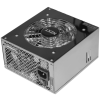
NZXT has impressed us quite a bit with their Lexa and Apollo cases, so we were looking forward to giving their entry into the PSU market a spin! It proves itself to be a supply worthy of your consideration, but is a wee bit overpriced.
Page 1 – Introduction
In the little time that NZXT has been around, they have made quite a splash in the PC case market. In a sense, they came out of nowhere. Usually companies start off slow and offer mundane products but that was not the case here. To date, I’ve reviewed two of their cases, the Lexa and Apollo. They received 9/10 and 10/10 scores, respectively. Today, both my primary PC’s still use those cases and I swear by them. So, needless to say NZXT made me a fan pretty quickly.
Like many other companies, NZXT took the natural step beyond their flagship products and decided on PSU’s. OCZ has been in the PSU business for a while, same with Thermaltake. But we see this ‘craze’ spreading like wildfire. Even Corsair and Mushkin recently launched a PSU line! Obviously, companies understand the need for big power supplies to feed our gaming rigs.

They have both a 550W and 650W version of the Precise, and we will be taking a look at the latter today. It is equipped with dual +12v rails, which should assure clean power to your CPU and other components. This is also becoming a fad, but is a sensible one… the more +12v rails, the better. There is even one on the market that includes five +12v’s, although that’s a little extreme ;-)
Here are the official features for the Precise:
- Nvidia sli ready certified
- Four sata connectors for more hard drive capacity
- Built for stability and less ripple noise keeping your devices safe while maintaining low noise via 120mm cooling fan.
- Combined power technology: automatic switching between standard dual +12v rails and combined power of both +12v rails.
- Hush silent technology keeps noise quietly below 30 dba at full load.
- Fully supports the rush power consumption of high frequency cpu & graphic cards.
- +12v current increased to meet more peripheral devices and high-end cpu
- Supports high end graphic card’s pci express requirements
- +5vsb current up to 2.5a to fully support more usb 2.0 plug and play devices.
- Industry standard protection: over voltage, current, short circuit, scan-disk-free, and voltage surge protection.
- Stable regulation on +3.3v / +5v / +12b at 5%
- Input
- AC Input Range: 1 15/230 Vac
- Frequency: 60/50 Hz
- Inrush Current: 30A/115Vac, 60A/230A
- Connectors
- 24-Pin Motherboard
- 8-Pin (Or 4-Pin) Motherboard
- 2 6-Pin PCI-E
- 3 4-Pin Fan
- 3 3-Pin Fan
- 4 S-ATA
- 2 Floppy

There are a few things to note here. First, this is an SLI certified power supply, meaning it’s designed with those setups in mind. There’s also something they call “Combined Power Technology” which involves both of the +12v rails. If there is no need for a dual +12v, then it combines the power output of both… to essentially make it one with 40a.
Stable regulation is 5% on all rails, so we will see throughout our tests if that holds true. In place also are the usual protections you would expect, including under/over voltage and short circuit protection. Before we give the PSU a good stress, let’s take a quick look at the retail packaging and supply itself.
|
|

Support our efforts! With ad revenue at an all-time low for written websites, we're relying more than ever on reader support to help us continue putting so much effort into this type of content. You can support us by becoming a Patron, or by using our Amazon shopping affiliate links listed through our articles. Thanks for your support!

Rob Williams
Rob founded Techgage in 2005 to be an 'Advocate of the consumer', focusing on fair reviews and keeping people apprised of news in the tech world. Catering to both enthusiasts and businesses alike; from desktop gaming to professional workstations, and all the supporting software.


