
- Qualcomm Launches Snapdragon 4 Gen 2 Mobile Platform
- AMD Launches Ryzen PRO 7000 Series Mobile & Desktop Platform
- Intel Launches Sleek Single-Slot Arc Pro A60 Workstation Graphics Card
- NVIDIA Announces Latest Ada Lovelace Additions: GeForce RTX 4060 Ti & RTX 4060
- Maxon Redshift With AMD Radeon GPU Rendering Support Now Available

Social & RSS Feeds
Latest Videos

Latest News
Phenom II X6 1090T – AMD Enters the Six-Core Arena

by Rob Williams on April 28, 2010 in Processors
In March, it was Intel’s turn, and this month, it’s AMD’s. That’s right, we’re at the point when Phenom II X6’s are hitting the market and giving consumers a much less expensive six-core CPU to chose from. We’re taking a look at AMD’s top-end offering, the 1090T BE, and also a brief look at the company’s new 890FX chipset.
Page 6 – Multi-Media: ProShow Gold, Sandra Multi-Media
While TMPGEnc XPress’ purpose is to convert video formats, ProShow from Photodex helps turn your collection of photos into a fantastic-looking slide show. I can’t call myself a slide show buff, but this tool is unquestionably definitive. It offers many editing abilities and the ability to export in a variety of formats, including a standard video file, DVD video and even HD video.
Like TMPGEnc and many other video encoders, ProShow can take full advantage of a multi-core processor. It doesn’t support SSE4 however, but hopefully will in the future as it would improve encoding times considerably. Still, when a slide show application handles a multi-core processor effectively, it has to make you wonder why there is such a delay in seeing a wider-range of such applications on the marketplace.

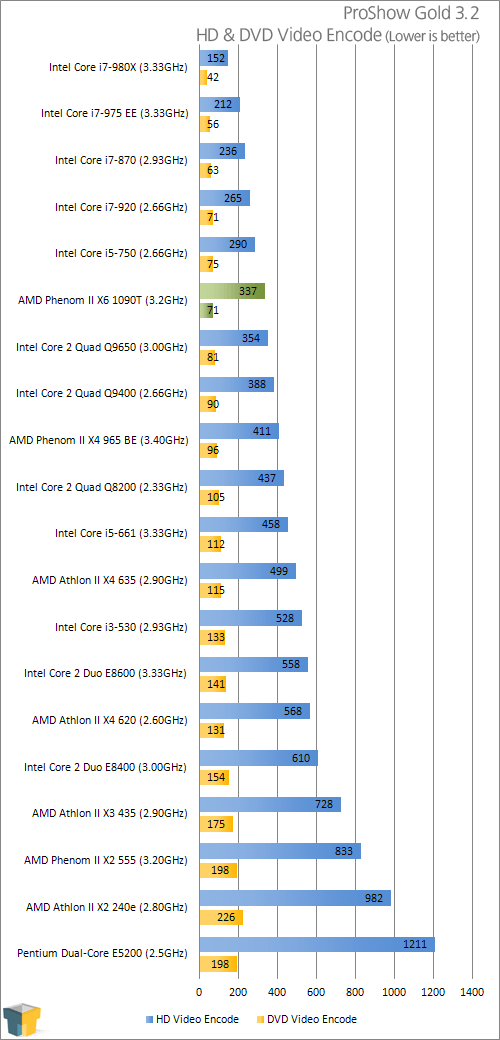
It may seem a bit odd that a six-core AMD chip falls behind the quad-core with no HT Core i5-750, but the difference here is the SSE4 instruction set. Intel has it, AMD doesn’t, so the latter has a hard time catching up where it’s used.
Sandra 2009 Multi-Media
This test here stresses the CPU’s ability to handle multi-media instructions and data, using both MMX and SSE2/3/4 as the instruction sets of choice. The results are divided by integer, floating point and double precision, three specific numbering formats used commonly in multi-media work.
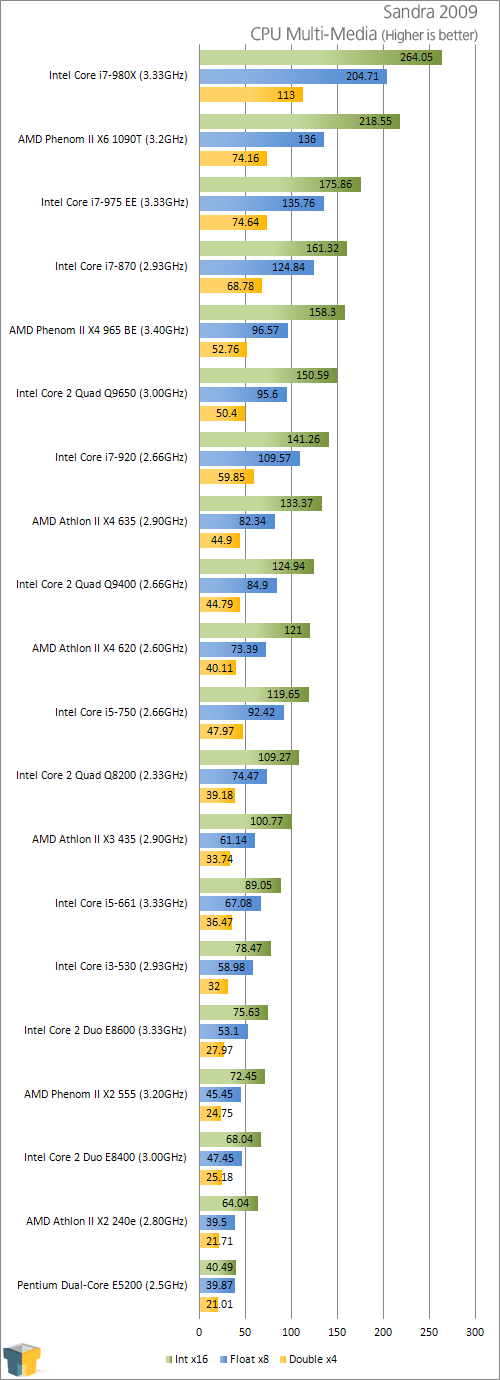
The 1090T once again shows off some impressive results, surpassing the Core i7-975 in each and every test (especially the Integer run).

Support our efforts! With ad revenue at an all-time low for written websites, we're relying more than ever on reader support to help us continue putting so much effort into this type of content. You can support us by becoming a Patron, or by using our Amazon shopping affiliate links listed through our articles. Thanks for your support!

Rob Williams
Rob founded Techgage in 2005 to be an 'Advocate of the consumer', focusing on fair reviews and keeping people apprised of news in the tech world. Catering to both enthusiasts and businesses alike; from desktop gaming to professional workstations, and all the supporting software.


