
- Qualcomm Launches Snapdragon 4 Gen 2 Mobile Platform
- AMD Launches Ryzen PRO 7000 Series Mobile & Desktop Platform
- Intel Launches Sleek Single-Slot Arc Pro A60 Workstation Graphics Card
- NVIDIA Announces Latest Ada Lovelace Additions: GeForce RTX 4060 Ti & RTX 4060
- Maxon Redshift With AMD Radeon GPU Rendering Support Now Available

Social & RSS Feeds
Latest Videos


Latest News
WD Black 4TB Hard Drive Review

by Rob Williams on January 2, 2013 in Storage
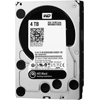
WD’s Black 4TB is the sort of product that doesn’t need much of an introduction – it speaks for itself. We’re dealing with a standard-sized desktop hard drive that sports a market-leading 4TB of storage. That’s 4,000GB, for those not paying enough attention. It’s impressive on paper, so let’s see how it fares in our benchmarks.
Page 7 – Final Thoughts
Thanks to the rising popularity of SSDs, it’s become a little challenging writing a review for a mechanical drive. However, while HDD performance pales in comparison to an SSD, it still matters. Kind of – allow me to explain.
Years ago, well before SSDs were considered affordable, hard drive performance mattered a lot. It’s what housed our OS and applications, after all, so a drive that proved 10% faster was tough to ignore. Today, though, as many people are using an SSD as their primary (OS) drive, hard drive performance may or may not be truly important. It depends on your needs.
If all you’re using a hard drive for is to store data, performance is clearly not a major issue. If you kick-off a movie on either an SSD or a mechanical drive, for example, the performance won’t seem too different. Where things change is if you skip through the file – faster storage has obvious advantages. That leads me to the main point where hard drive performance can matter. If you work with these stored files a lot, such as for your personal projects (video, audio, images, et cetera), a faster drive is undoubtedly appreciated. SSDs might be affordable for a modest drive, but they’re still outside the realm of possibility when you need to store terabytes of data.
To WD’s favor, that’s what will sell its 4TB Black drive. It’s for those who need both high storage and high performance. I’d still be quicker to recommend WD’s own VelociRaptor for a nice blend of both factors, but it carries a price-premium and maxes out at 1TB – it’s not exactly sharing the same target market as this Black drive.

That all said – does WD’s Black 4TB properly fill its role? Yes and no. As far as 4TB storage is concerned, your options are limited, so if you need that kind of storage now, you’re buying either this drive or HGST’s (a WD company). Currently, the HGST drive retails for $310, while this Black retails for $330. While we haven’t tested the HGST drive, based on specs alone I’d expect both drives to perform similarly.
On the topic of latency, I found that to be an odd point about this drive. Given the beefier platter size, you’d almost expect the 4TB drive to be faster than the 2TB model, but not so. In fact, this Black 4TB even managed to get out-performed by WD’s own Green drive (2TB). That seems a bit silly. Transfer-speed wise, while the 4TB model still doesn’t beat out the 2TB one, its performance is close.
With a drive like this, you have to take the good with the bad. Since WD employed 1TB platters in its Red series drives, I had hoped that we’d see that carried over to this Black drive, but it’s clear that WD hasn’t yet optimized those platters for faster speeds. Had WD been able to put those platters in this drive, we would have seen far-improved performance I’m sure.
When all said and done, WD’s Black is a solid choice for those who need massive storage, but it’s impossible to ignore HGST’s drive which retails for $20 less. It’s expected that Seagate will release its first 4TB drive early this year, so it will be interesting to see how that drive will fare in the performance department.
To wrap this up, I have to say that it’s a little disappointing to see that the price of the HGST 4TB drive went up in price pretty significantly once the Black 4TB model was released. When we first talked about the Black 4TB in November, HGST’s drive retailed for $279.99. Post-release, it jumped to $309.99. Coincidence? I have my doubts. That said, even at $330, the drive offers a good value in comparison to the 2TB model ($0.0825 per GB vs. $0.09 per GB).
Pros
- It’s 4TB!
- Offers good transfer performance.
- No price premium vs. Black 2TB: $0.0825 per GB vs. $0.09 per GB (note: Green 2TB = $0.055 per GB).
Cons
- Poor latency performance; out-shined by WD’s Green drives.

Support our efforts! With ad revenue at an all-time low for written websites, we're relying more than ever on reader support to help us continue putting so much effort into this type of content. You can support us by becoming a Patron, or by using our Amazon shopping affiliate links listed through our articles. Thanks for your support!

Rob Williams
Rob founded Techgage in 2005 to be an 'Advocate of the consumer', focusing on fair reviews and keeping people apprised of news in the tech world. Catering to both enthusiasts and businesses alike; from desktop gaming to professional workstations, and all the supporting software.


