
- Qualcomm Launches Snapdragon 4 Gen 2 Mobile Platform
- AMD Launches Ryzen PRO 7000 Series Mobile & Desktop Platform
- Intel Launches Sleek Single-Slot Arc Pro A60 Workstation Graphics Card
- NVIDIA Announces Latest Ada Lovelace Additions: GeForce RTX 4060 Ti & RTX 4060
- Maxon Redshift With AMD Radeon GPU Rendering Support Now Available

Social & RSS Feeds
Latest Videos

Latest News
Move Aside, GTX 680: NVIDIA GeForce GTX 770 Review

by Rob Williams on May 30, 2013 in Graphics & Displays
Though it might seem a bit unusual to see NVIDIA let loose its GTX 770 a mere week after its 780 launch, here’s something to clear things up: $399. Built on GK104 (not GK110, like the 780), the GTX 770 is in effect a beefed-up GTX 680. It boasts 700 series features, NVIDIA’s latest cooler, and of course, a savings of about $100.
Page 1 – Introduction
In late 2010, NVIDIA unveiled the second model to populate its GeForce 500 series, the GTX 570. With it came a card that performed just about on-par with the previous-generation’s champ, the GTX 480. Fast-forward to today, and we’re experiencing a bit of a deja vu moment; the just-announced GTX 770 becomes the direct replacement of the GTX 680.
To call NVIDIA’s GeForce GTX 770 a “GTX 680 w/ a new name” would be a major understatement, however. While it is based on the same GK104 architecture, unlike the GK110 which the GTX 780 (our review) uses, it bundles in all of the 700 series niceties (such as GPU Boost 2.0), sports the same cooler as the GTX 780, and, perhaps best of all, is priced at $399 USD.
Considering the fact that the GTX 780 is priced $150 higher than the GTX 680 was at its launch, it’s worth noting that the GTX 770 retains the same pricing that the GTX 670 had at its launch. Why? Because GTX 780 is based on the same silicon as TITAN and brings with it a couple of nice perks, such as 3GB (or 6GB) of GDDR5 and a 384-bit memory bus.
Given that, it might seem that the GTX 770 should be called the GTX 680 Ti or something similar, but because the 770 includes some exclusive 700 series perks (like GPU Boost 2.0 as mentioned above), NVIDIA’s naming scheme is justified. And, well, with 700 having launched, it makes no sense to roll-out a new product with an old name.

So, let’s speculate. With a $250 gap between GTX 770 and GTX 780, it seems inevitable that a $500 option will hit after NVIDIA’s able to get some lower-end models out there. With the advent of high-res gaming (we’re talking above 1080p), a 3GB framebuffer almost seems like it should be a given at this point, but it’s not possible on GK104. The 384-bit memory bus is also important. Those features along with a clock boost would justify a $500 price-tag quite well. The upside to a model like this is that it wouldn’t affect the GTX 780’s market placement at all, thanks to the fact that it bundles in 50% more cores. If NVIDIA wanted to deliver a knockout punch to AMD, it could boost the “GTX 770 Ti” core count to 1,920.
If it turns out that I’m way off the mark with that speculation, I’ll just put the blame on this delicious, ice cold thought-enhancing Maudite.
As per the usual, let’s take a quick look at NVIDIA’s current lineup:
| NVIDIA GeForce Series | Cores | Core MHz | Memory | Mem MHz | Mem Bus | TDP |
| GeForce GTX Titan | 2688 | 837 | 6144MB | 6008 | 384-bit | 250W |
| GeForce GTX 780 | 2304 | 863 | 3072MB | 6008 | 384-bit | 250W |
| GeForce GTX 770 | 1536 | 1046 | 2048MB | 7010 | 256-bit | 230W |
| GeForce GTX 690 | 3072 | 915 | 2x 2048MB | 6008 | 256-bit | 300W |
| GeForce GTX 680 | 1536 | 1006 | 2048MB | 6008 | 256-bit | 195W |
| GeForce GTX 670 | 1344 | 915 | 2048MB | 6008 | 256-bit | 170W |
| GeForce GTX 660 Ti | 1344 | 915 | 2048MB | 6008 | 192-bit | 150W |
| GeForce GTX 660 | 960 | 980 | 2048MB | 6000 | 192-bit | 140W |
| GeForce GTX 650 Ti BOOST | 768 | 980 | 2048MB | 6008 | 192-bit | 134W |
| GeForce GTX 650 Ti | 768 | 925 | 1024MB | 5400 | 128-bit | 110W |
| GeForce GTX 650 | 384 | 1058 | 1024MB | 5000 | 128-bit | 64W |
| GeForce GT 640 | 384 | 900 | 2048MB | 5000 | 128-bit | 65W |
| GeForce GT 630 | 96 | 810 | 1024MB | 3200 | 128-bit | 65W |
| GeForce GT 620 | 96 | 700 | 1024MB | 1800 | 64-bit | 49W |
| GeForce GT 610 | 48 | 810 | 1024MB | 1800 | 64-bit | 29W |
While the GTX 770 is based on the same chip as the GTX 680, both of its clocks have seen a boost, resulting in a TDP bump from 195W to 230W – rather substantial. As we’ll see in our testing, though, it’s a bump that reflects itself in our benchmarks.
You might have noticed a “7” there in the Mem MHz section – and no, that’s no typo. For the first time on a graphics card, NVIDIA’s offering GDDR5 at speeds of 7,010MHz, boasting bandwidth of 224.3GB (+15% over GTX 680). This increase, along with the clock boost to 1,046MHz, should result in some interesting benchmarking.
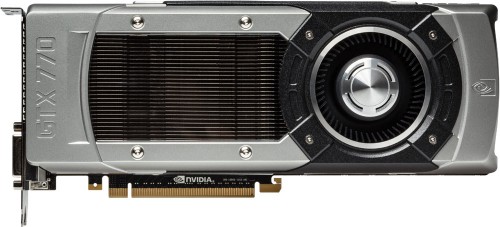
When I first tore the GTX 770 out of its box, the first thing I thought was, “Welp, this isn’t going to be $400.” I had figured that NVIDIA was going to price the GTX 770 to align with AMD’s Radeon HD 7970 GHz Edition at ~$450, even though both were likely to come out about even in performance. So, NVIDIA made a great move with retaining its X70 pricing here. The GTX 770 looks to be an attractive card inside and out.
After a quick look at our test rig and methodologies, we’ll get right into our first benchmark: Battlefield 3.

Support our efforts! With ad revenue at an all-time low for written websites, we're relying more than ever on reader support to help us continue putting so much effort into this type of content. You can support us by becoming a Patron, or by using our Amazon shopping affiliate links listed through our articles. Thanks for your support!

Rob Williams
Rob founded Techgage in 2005 to be an 'Advocate of the consumer', focusing on fair reviews and keeping people apprised of news in the tech world. Catering to both enthusiasts and businesses alike; from desktop gaming to professional workstations, and all the supporting software.


