
- Qualcomm Launches Snapdragon 4 Gen 2 Mobile Platform
- AMD Launches Ryzen PRO 7000 Series Mobile & Desktop Platform
- Intel Launches Sleek Single-Slot Arc Pro A60 Workstation Graphics Card
- NVIDIA Announces Latest Ada Lovelace Additions: GeForce RTX 4060 Ti & RTX 4060
- Maxon Redshift With AMD Radeon GPU Rendering Support Now Available

Social & RSS Feeds
Latest Videos

Latest News
OCZ 2GB PC2-9200 Reaper HPC Edition

by Rob Williams on April 25, 2007 in Miscellaneous
OCZ is an innovative company and it’s easily seen by viewing their product line-up. They recently announced a new passive heatspreader dubbed Reaper HPC. Is this the fanless overclockers dream?
Page 2 – Overclocking and Testing Methodology, Sandra
|
|
The first thing I do whenever I receive a new kit of memory for review is find out it’s price. From there, I can see exactly who it’s marketed to and can usually also garner what kind of overclocking ability I should except. Luckily enough though, even value kits lately have been quite overclockable, thanks to Micron D9GMH chips, which I assume is what the Reaper HPC use simply because they are chips that offer superb performance for a good price.
That said, these modules retail for $319.99 on average. So, it’s placed close to “high-end”. I perused a few e-tailers websites and found that OCZ is one of the few companies to actually sell modules at this speed. The only other company was Mushkin and that particular kit was $100 more. As for faster, Kingston takes that crown with their PC2-9600 kits, none of which were in stock when I looked. So overclocking aside, given the stock speeds and price, this is a great kit.
Pricing aside, I had a couple goals to seek out while testing these modules. First and foremost, I wanted to see how much of a difference the passive heatspreader made. I don’t have a digital thermometer, so I am playing everything by “finger”. I will get more into this in the conclusion. The second goal is to see how far these can be pushed. Given their price and stock speeds, I assumed they would hit at least PC2-9600 speeds or slightly higher.
That said, here are my results, after a few nights of testing:
- 400MHz (DDR2-800), 1.9v, 4-4-4-12-13
- 450MHz (DDR2-900), 2.1v, 4-4-3-12-13
- 500MHz (DDR2-1000), 2.1v, 4-4-4-12-13
- 533MHz (DDR2-1066), 2.35v, 4-4-4-12-13
- 575MHz (DDR2-1150), 2.45v, 5-5-5-18-13
- 642MHz (DDR2-1284), 2.5v, 5-5-5-18-19
As you can see, the results are rather impressive. 642MHz proved to be the kits maximum stable overclock, and in turn became the highest DDR2 overclock I’ve had. Second place now belongs to Corsairs Dominator 9136 kit.

You might have noticed that I am using tRC 19. Normally I try to keep that a tad lower, ie: 13 like the rest of them, but even with 16, MemTest errored at the 500% mark. Bumping up to 19 allowed a completely stable overclock that also proved 3D Mark 06 stable.
Testing Methodology
Throughout all of our benchmarks regardless of what we are reviewing, testing is done in a clean and stand-alone version of Windows XP Professional with SP2. Prior to testing, these conditions are met:
- Desktop and scrap files are cleaned up, including emptying of recycle bin.
- No virus scanner or firewall is installed in the stand-alone installation.
- The stand-alone installation drive is completely defragged using Diskeeper 2007 Professional.
- All unnecessary programs are closed, so that Windows should have no more than 15 active processes running.
- Computer has proper airflow.
The testing rig used for today’s benchmarking is as follows:
- CPU: Intel Q6600 (2.4GHz – 2.89GHz)
- Motherboard: eVGA nForce 680i (P27 BIOS)
- Memory: OCZ 2GB Reaper HPC PC2-9200
- Video: ASUS EN8800GTX 768MB
- Sound: Onboard HD Audio
- Storage: Seagate 7200.9 320GB
- Etcetera: Windows XP Professional w/ SP2
- Cooling: Corsair Nautilus 500
(Products linked are to our own reviews)
Most of the results listed deal with how all of our settings scaled, although there will be direct comparisons to other kits of ram as well. For the sake of congruency, I followed the same overclocking rates as previous reviews.
Sandra XI
Sandra is always the first benchmark to come to mind when we need to do memory benchmarking. Or CPU benchmarking. Or storage benchmarking. You get the idea. It’s a superb all-around tool that we rely on quite often.
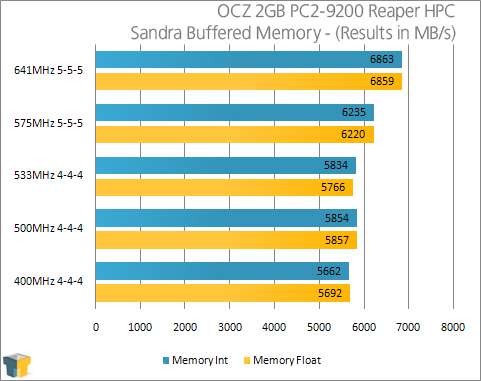
Are we going to find a kit that allows us to hit 7,000MB/s with a 1:1 ratio? If not, we certainly came close here.
|
|

Support our efforts! With ad revenue at an all-time low for written websites, we're relying more than ever on reader support to help us continue putting so much effort into this type of content. You can support us by becoming a Patron, or by using our Amazon shopping affiliate links listed through our articles. Thanks for your support!

Rob Williams
Rob founded Techgage in 2005 to be an 'Advocate of the consumer', focusing on fair reviews and keeping people apprised of news in the tech world. Catering to both enthusiasts and businesses alike; from desktop gaming to professional workstations, and all the supporting software.


